
When it comes to choosing the right round bar for your construction, fabrication, or industrial application, the most common decision comes down to stainless steel and mild steel. Both materials are commonly utilized in manufacturing, yet serve different functions because of their distinct compositions, characteristics, and pricing.
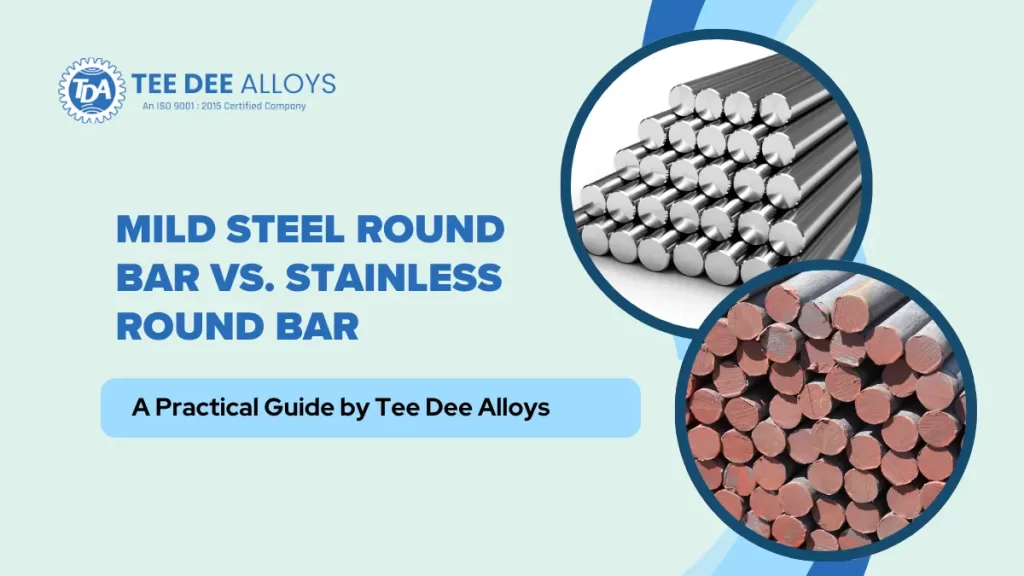
In this blog, we will explore the distinctions between stainless steel round bars and mild steel round bars to help you make a well-informed decision for your project.
What is a Round Bar?
A round bar is a lengthy cylindrical metal rod that maintains a uniform circular cross-section. It can be constructed from various materials, including mild steel, stainless steel, aluminum, or alloy steel. Round bars play a crucial role in applications such as shafts, fasteners, supports, fabrication components, and frames.
Comprehending Mild Steel Round Bars:
Mild steel (MS) round bars are produced from low-carbon steel, generally comprising 0.15% to 0.25% carbon.
Key Characteristics of MS Round Bars:
- Economical and easily accessible
- High ductility and malleability
- Well-suited for welding, cutting, and machining
- Appropriate for general fabrication, construction, brackets, and structural uses
Drawbacks:
- Susceptible to corrosion if not coated or painted
- Reduced strength and wear resistance in comparison to alloyed or stainless steels
Comprehending Stainless Steel Round Bars:
Stainless steel round bar is solid cylindrical rods crafted from stainless steel alloys that resist corrosion. Typical grades consist of SS304, SS316, and SS202, each designed for specific environments and strength needs.
Key Characteristics of Stainless Round Bars:
- Resistant to corrosion and rust, perfect for harsh conditions.
- Sanitary, appropriate for food-grade and medical applications.
- Exhibits superior tensile strength and durability.
- Presents a visually appealing finish (frequently polished).
Drawbacks:
- Costlier than mild steel.
- Might need specialized equipment for cutting or welding.
Key Comparison: Stainless vs. Mild Steel Round Bars
| Property | Mild Steel Round Bar | Stainless Steel Round Bar |
| Corrosion Resistance | Low (requires coating) | High (self-passivating) |
| Strength & Durability | Moderate | High |
| Weldability | Excellent | Good (depends on grade) |
| Cost | Affordable | Relatively expensive |
| Aesthetic Appearance | Plain, requires finishing | Naturally polished and attractive |
| Applications | Structural, fabrication, supports | Chemical, food-grade, marine, hygiene |
- Choose Mild Steel Round Bars if:
- Budget is a concern
- You need easy-to-machine or weld materials
- The project is indoors or protected from moisture
- Budget is a concern
- Choose Stainless Round Bars if:
- You need corrosion resistance (e.g., marine, food processing)
- A clean, polished finish is important
- You’re working in chemical, medical, or outdoor environments
- You need corrosion resistance (e.g., marine, food processing)
End Note:
The round bar forms of stainless and mild steel round bar provide separate advantages that match different applications. Knowledge of these differences helps you make an informed choice about the product. The selection of mild steel round bar proves suitable for projects that need robust material at reduced prices. Stainless steel round bars provide superior corrosion resistance and longevity, making them your top choice.
Still thinking about which one is best for your project? Our professional staff at Tee Dee Alloys helps businesses & individuals with steel matching by grade, project type, and fast delivery schedule.